

-
1 ящик (тара)
ящик
Транспортная тара с корпусом, имеющим в сечении, параллельном дну, преимущественно форму прямоугольника, с дном, двумя торцовыми и боковыми стенками, с крышкой или без нее
[ ГОСТ 17527-86]EN
crate
A rough packing case of open construction made from timber slats.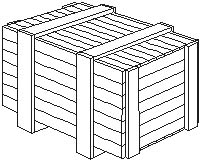
Дощатый ящик (boarded crate)Недопустимые, нерекомендуемые
Тематики
- тара, стеллажи
EN
DE
FR
Русско-немецкий словарь нормативно-технической терминологии > ящик (тара)
-
2 длительный допустимый ток
- Strombelastbarkeit, f
- Dauerstrombelastbarkeit, f
(длительный) допустимый ток
Максимальное значение электрического тока, который может протекать длительно по проводнику, устройству или аппарату при определенных условиях без превышения определенного значения их температуры в установившемся режиме
[ ГОСТ Р МЭК 60050-826-2009]
Этот ток обозначают IZ
[ ГОСТ Р 50571. 1-2009 ( МЭК 60364-1: 2005)]EN
(continuous) current-carrying capacity
ampacity (US)
maximum value of electric current which can be carried continuously by a conductor, a device or an apparatus, under specified conditions without its steady-state temperature exceeding a specified value
[IEV number 826-11-13]
ampacity
The current in amperes that a conductor can carry continuously under the conditions of use without exceeding its temperature rating.
[National Electrical Cod]FR
courant (permanent) admissible, m
valeur maximale du courant électrique qui peut parcourir en permanence, un conducteur, un dispositif ou un appareil, sans que sa température de régime permanent, dans des conditions données, soit supérieure à la valeur spécifiée
[IEV number 826-11-13]Ampacity, the term is defined as the maximum amount of current a cable can carry before sustaining immediate or progressive deterioration. Also described as current rating or current-carrying capacity, is the RMS electric current which a device can continuously carry while remaining within its temperature rating. The ampacity of a cable depends on:
- its insulation temperature rating;
- conductor electrical properties for current;
- frequency, in the case of alternating currents;
- ability to dissipate heat, which depends on cable geometry and its surroundings;
- ambient temperature.
Electric wires have some resistance, and electric current flowing through them causes voltage drop and power dissipation, which heats the cable. Copper or aluminum can conduct a large amount of current before melting, but long before the conductors melt, their insulation would be damaged by the heat.
The ampacity for a power cable is thus based on physical and electrical properties of the material & construction of the conductor and of its insulation, ambient temperature, and environmental conditions adjacent to the cable. Having a large overall surface area may dissipate heat well if the environment can absorb the heat.
In a long run of cable, different conditions govern, and installation regulations normally specify that the most severe condition along the run governs the cable's rating. Cables run in wet or oily locations may carry a lower temperature rating than in a dry installation. Derating is necessary for multiple circuits in close proximity. When multiple cables are near, each contributes heat to the others and diminishes the amount of cooling air that can flow past the individual cables. The overall ampacity of the insulated conductors in a bundle of more than 3 must be derated, whether in a raceway or cable. Usually the de-rating factor is tabulated in a nation's wiring regulations.
Depending on the type of insulating material, common maximum allowable temperatures at the surface of the conductor are 60, 75 and 90 degrees Celsius, often with an ambient air temperature of 30°C. In the U.S., 105°C is allowed with ambient of 40°C, for larger power cables, especially those operating at more than 2 kV. Likewise, specific insulations are rated 150, 200 or 250°C.
The allowed current in cables generally needs to be decreased (derated) when the cable is covered with fireproofing material.
For example, the United States National Electric Code, Table 310-16, specifies that up to three 8 AWG copper wires having a common insulating material (THWN) in a raceway, cable, or direct burial has an ampacity of 50 A when the ambient air is 30°C, the conductor surface temperature allowed to be 75°C. A single insulated conductor in air has 70 A rating.
Ampacity rating is normally for continuous current, and short periods of overcurrent occur without harm in most cabling systems. The acceptable magnitude and duration of overcurrent is a more complex topic than ampacity.
When designing an electrical system, one will normally need to know the current rating for the following:- Wires
- Printed Circuit Board traces, where included
- Fuses
- Circuit breakers
- All or nearly all components used
Some devices are limited by power rating, and when this power rating occurs below their current limit, it is not necessary to know the current limit to design a system. A common example of this is lightbulb holders.
[http://en.wikipedia.org/wiki/Ampacity]
Тематики
- электротехника, основные понятия
Синонимы
EN
DE
- Dauerstrombelastbarkeit, f
- Strombelastbarkeit, f
FR
- courant admissible, m
- courant permanent admissible, m
Русско-немецкий словарь нормативно-технической терминологии > длительный допустимый ток
См. также в других словарях:
Case CE — Case CE, also Case Construction Equipment or simply Case, is a brand of construction equipment from CNH Global. Under this brand name, CNH Global is the third biggest manufacturer of construction equipment behind CAT (#1) and Komatsu… … Wikipedia
Case Corporation — Saltar a navegación, búsqueda Case Corporation Fundación 1842 Sede Estados Unidos Industria Agricultura Productos … Wikipedia Español
Case IH — is an American mechanical company, one of the world’s largest brands of agricultural equipment. With headquarters in Racine, Wisconsin, it has a network of more than 4,000 dealers and distributors that operates in more than 160 countries. Case IH … Wikipedia
Case Modding — (von engl. case = Gehäuse, engl. modification = Veränderung) ist primär das Verändern der äußeren Erscheinungsform des PCs zur optischen Aufwertung. Hierzu zählt hauptsächlich die optische Bearbeitung der im normalen Gehäuse nicht sichtbaren… … Deutsch Wikipedia
Case CE — ist eine Marke der CNH Global für Baumaschinen und steht abgekürzt für „Case Construction Equipment“. Mit dieser Marke ist CNH der drittgrößte Hersteller von Baumaschinen hinter dem Marktführer Caterpillar (CAT) und Komatsu. Logo von Case CE … Deutsch Wikipedia
Case-Modding — (von engl. case = Gehäuse, engl. modification = Veränderung) ist primär das Verändern der äußeren Erscheinungsform des PCs zur optischen Aufwertung. Hierzu zählt hauptsächlich die optische Bearbeitung der im normalen Gehäuse nicht sichtbaren… … Deutsch Wikipedia
Case-modding — (von engl. case = Gehäuse, engl. modification = Veränderung) ist primär das Verändern der äußeren Erscheinungsform des PCs zur optischen Aufwertung. Hierzu zählt hauptsächlich die optische Bearbeitung der im normalen Gehäuse nicht sichtbaren… … Deutsch Wikipedia
Case (policy debate) — articleissues|article=on context = October 2008 jargon = October 2008 onesource = October 2008 citations missing = October 2008In the policy debate form of debate competition, the case is the advocacy established by the affirmative in the First… … Wikipedia
Case Corporation — (formerly J.I. Case Company) was a manufacturer of construction and agricultural equipment. In 1999 it merged with New Holland to form CNH Global. The name Case lives on in two brands of the company: * Under the Case CE (for Construction… … Wikipedia
construction — con·struc·tion /kən strək shən/ n: the act or result of construing, interpreting, or explaining meaning or effect (as of a statute or contract) the construction placed upon an agreement J. D. Calamari and J. M. Perillo Merriam Webster’s… … Law dictionary
Construction surveying — (otherwise known as lay out or setting out ) is to stake out reference points and markers that will guide the construction of new structures such as roads or buildings. These markers are usually staked out according to a suitable coordinate… … Wikipedia
